
Key points:
Gamification in e-learning is a design approach that borrows mechanics from games (points, badges, leaderboards, progress tracking) and applies them to learning activities to influence learner motivation and engagement.
– Most WordPress LMS platforms, including LearnDash and LifterLMS, already include the core gamification mechanics natively
– Gamification is not the same as game-based learning, which uses an actual game as the learning activity itself
– The problem it addresses: self-paced online courses remove the external accountability structures that keep learners on track in a classroom setting
– Beyond keeping learners engaged, gamification can support course growth: shareable achievements and leaderboards draw learners back and generate organic visibility.
– Whether it belongs in a given WordPress LMS depends on the learner situation and the quality of the design, not just the presence of the mechanics
Most WordPress LMS owners have already run into gamification, usually without realizing it. Things like the badge settings, the certificate generator you configured at launch, or the leaderboard block are all gamification features. They look like ordinary LMS options, but each one offers an opportunity to improve learner motivation, if applied thoughtfully.
Gamification gets described a lot of ways: as a motivational tool, a retention tactic, or a way to make learning feel less like a chore. While those things can be true, what actually matters is approaching gamification as a design philosophy rather than a feature list. These features are tools aimed at specific problems, and understanding the problem is most of the way to knowing whether any of those tools are worth using.
What gamification actually means
Gamification means applying game elements to things that aren’t games (like a training course or a lesson) to shape how people engage with them. In an e-learning setting, those elements are the mechanics that make games motivating: visible progress, recognition of achievement, feedback, competition, and reward.
Some examples:
- A progress bar at the top of a course page makes a course feel navigable rather than endless;
- Badges mark milestones and give learners something to point to;
- Points build up into a running score over time;
- Leaderboards show where a learner sits relative to others;
- A certificate marks the end of a course and provides a credential worth sharing.
Each mechanic works on a different aspect of motivation. Progress bars help because people push harder when a goal feels close, and because seeing how far they’ve come is a reminder of what they’d be throwing away by quitting. Badges and certificates tap into identity: finishing something and having proof of it reinforces the sense that you’re someone who does this kind of work. Points give small, steady rewards that keep people coming back day to day. Leaderboards introduce social comparison, which is one of the stronger motivators in learning contexts, though not always in the direction you’d expect.
Most WordPress LMS platforms (LearnDash and LifterLMS included) support this vocabulary natively or with minimal additional setup. What varies from site to site is whether the design behind your setup uses these mechanics in a way that serves their purpose fully, and that starts with understanding the tools you’re working with.
Gamification vs. game-based learning
These two terms get used interchangeably often enough to create confusion when evaluating options.
Gamification means adding game mechanics to an existing non-game activity. The activity stays the same; the mechanics sit around it to shape how learners engage with it. A standard video lesson with a progress bar and a badge on completion is gamified learning. The lesson itself has not changed.
Game-based learning is different: the learning happens inside an actual game. The game is the activity, not a wrapper around it. A flight simulator is game-based learning. So is a branching medical scenario where a wrong call has consequences, or a game that teaches budgeting by making the player run a household on a fixed income. The gameplay isn’t wrapped around the lesson. It is the lesson.
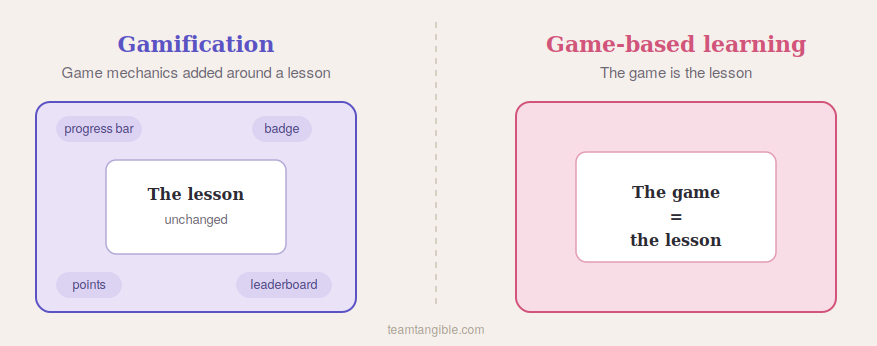
Adding gamification to an existing course is a design and configuration decision. Building game-based learning is a much bigger content and development project, because now you also have to build the game itself. They require different resources, and suit different learner situations.
If your learners need motivation and accountability to work through existing content, gamification is the relevant consideration.
Is gamification worth it for your WordPress LMS?
Whether gamification is worth investing in depends on what problem you’re trying to solve.
The engagement problem in self-paced e-learning
Self-paced online courses have a structural problem. In a classroom, accountability is built in: there is a teacher, classmates, a schedule, and social pressure to keep up. In a self-paced course on a WordPress LMS, none of that exists. A learner enrolls, opens the first lesson, then faces the rest of the course entirely on their own terms.
That shows up in completion data. Learners rarely drop out because the content is bad. They drop out because the friction of returning and continuing (without any external prompt to do so) gradually outweighs their motivation. It’s a structural problem rather than a content problem.
Gamification is a partial response to that structural problem. Progress bars give learners a visible sense of momentum, and a course that is 60% complete is less likely to be dropped than one with no clear finish line. Badges give learners something to work toward between major milestones. Points create a reason to return that does not depend entirely on willpower. Those mechanics can’t perfectly replicate the accountability of a classroom, but they rebuild some of what self-paced learning removes.
Studies on gamification in learning contexts generally lean positive on short-to-medium term engagement effects, though findings vary considerably depending on context, design, and how engagement is measured. What those engagement effects actually look like from the learner’s side, and where the motivation tends to fade, is worth understanding before you design for them.
The social and competitive dimension
Gamification does something the dropout-rate argument tends to underplay: it makes learners aware of each other.
With a leaderboard, learners return not just to progress through material but to see where they stand, to catch up, to stay ahead. That creates a different kind of engagement from completion-driven motivation. It turns learning into a shared experience, and on a WordPress LMS with an existing learner base, that shift can meaningfully change how people use the platform over time.
The other dimension is shareability. Achievements that feel worth sharing generate organic visibility for the course. A learner who posts a badge to LinkedIn, shares a completion certificate, or mentions a leaderboard position to colleagues is generating course awareness without being prompted. The psychology is the same one behind Duolingo streaks and LinkedIn certifications: people share proof of progress because it reflects well on them. For site owners, a well-designed achievement that learners want to share is also a signal that the gamification design is working. If nobody shares it, the achievement probably does not feel meaningful enough.
Designing for that social side on purpose, instead of letting it happen by accident, takes deliberate effort.
Where gamification falls short
Novelty fades. A badge system that feels engaging in the first week often stops registering by week six, particularly when badges do not reflect meaningful progression. Mechanics that add visible reward without genuine feedback loops become background noise.
It cuts both ways. A leaderboard in a competitive professional context can drive real engagement. The same leaderboard in a context where learners are already self-conscious can demotivate the bottom 80% and make top performers feel singled out. The mechanic is neutral, but the design isn’t.
Gamification can’t fix a content problem. If learners are disengaging because of confusion, frustration, or disinterest, adding points addresses none of that. The mechanics work on motivation. They do not work on content quality or ease-of-navigation. Once that distinction is clear, the practical question shifts to what implementation actually looks like and what it costs.
The question of whether gamification belongs in your WordPress LMS is much easier to answer once you understand what it’s actually doing. The mechanics are design decisions that work on a specific problem, and like any design decision, how well they work depends on how deliberately they are made.
At Tangible Inc., we work with WordPress LMS sites across the full stack, from course architecture to the design decisions that shape the learner experience.
If gamification is on your radar for your LMS, get in touch.
Frequently asked questions
What’s the difference between gamification and game-based learning?
Gamification adds game mechanics (points, badges, leaderboards, progress bars) to an existing non-game learning activity. The content stays the same; the mechanics shape how learners engage with it. Game-based learning uses an actual game as the learning activity itself: the learning happens through gameplay, not alongside it. Both can be effective, but they address different problems and require different levels of investment.
Does gamification actually work in e-learning?
Yes, with conditions. The evidence for improved motivation and engagement in self-paced learning environments is reasonably solid, particularly in the short to medium term. Long-term effectiveness depends on the quality of the design: mechanics that reflect meaningful progression work better than those that do not, and the right mechanic in the wrong context can actively reduce engagement.
Do LearnDash and LifterLMS support gamification natively?
Yes. Both platforms include the core gamification vocabulary: progress tracking, achievement badges, certificates, and points systems. LearnDash provides these through its native course progress features and Achievements add-on. LifterLMS includes achievement badges and certificates as built-in features. Both support integration with third-party plugins like GamiPress for more granular setups.h support integration with third-party plugins like GamiPress for more granular setups.